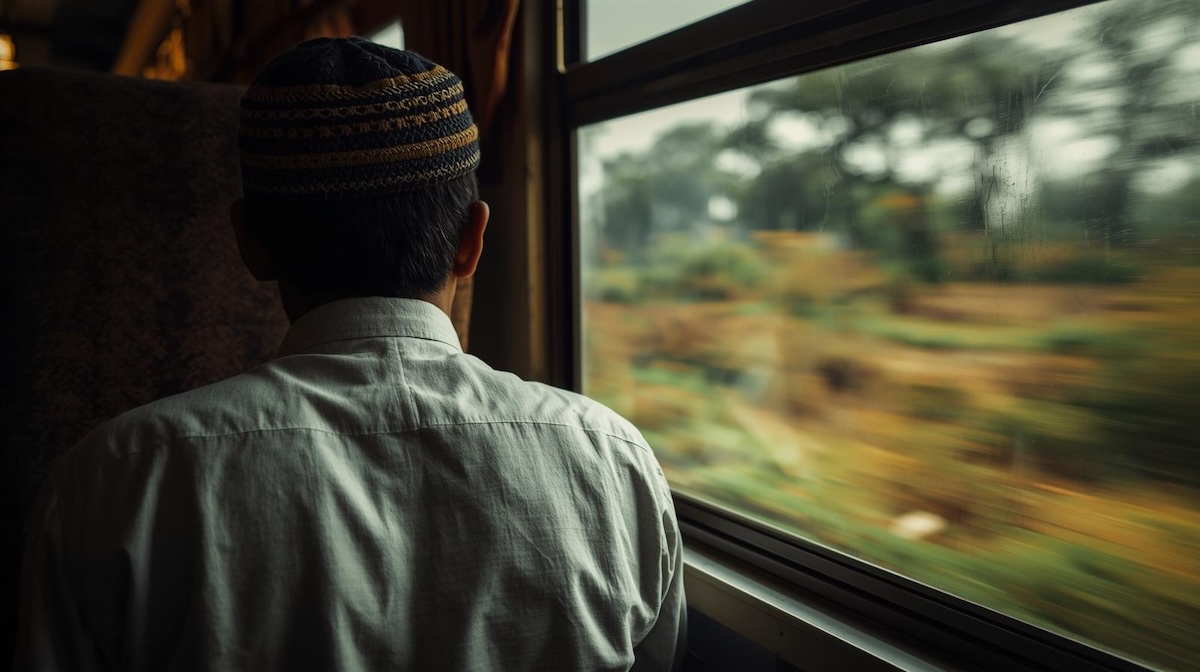

I was sitting by the train window. Outside, fields, small towns, and quiet stations slipped past in the hazy evening light. The train was moving quickly, but the questions in my mind were racing even faster. My destination was Assam, in eastern India. The journey itself was ordinary, yet I felt an unusual sense of unease.
I received my entire education at Darul Uloom Deoband. Its influence is clearly reflected in the way I dress and carry myself. My kurta, pajama, and beard are not merely clothing choices; they are part of a religious tradition. But on this journey, that very appearance became a source of quiet anxiety. Sitting on the train, I kept wondering whether someone might look at me with suspicion simply because of my beard or my traditional attire.
This fear was not just personal. In today’s India, Islamic identity itself has become a source of unease for many Muslims. A few years ago, a Muslim passenger was shot dead on a train after being asked his name. Incidents like this linger in people’s memories and often resurface at unexpected moments.
More recently, a comment by India’s former vice president, Jagdeep Dhankhar, made headlines when he said, “I am very afraid of bearded people.” Statements like this only deepen the sense of discomfort in an already tense atmosphere.
As I sat there, absentmindedly touching my beard, I found myself wondering: can a simple religious symbol really become something that makes others feel fear?
My destination was Assam, and perhaps that was adding to my anxiety. In recent years, the northeastern Indian state has become a focal point in debates about Islamophobia. The political narrative surrounding Muslims there has sparked discussion across the country.
Assam’s chief minister, Himanta Biswa Sarma, has repeatedly made strong statements about Muslims in the state, particularly about madrasas. On one occasion, he said the word “madrasa” itself should disappear, arguing that if the concept remains in people’s minds, children will not aspire to become doctors or engineers. He has also said that the government “cannot produce clerics” with public funds.
Against this backdrop, the Assam government closed 1,281 state-run madrasas and converted them into general schools. Officials described the move as part of an educational reform effort. But the political rhetoric surrounding the decision gave it a different meaning in public debate. Madrasas were suddenly portrayed not simply as educational institutions, but as a problem.
While the conditions of many of these schools were far from ideal, critics argue that the closures further reduced educational opportunities for many poor Muslim families.
Looking out the train window, I kept wondering what the atmosphere would be like in the state I was traveling to, especially when it came to Islamic identity. In recent years, media coverage and political rhetoric have increasingly portrayed beards and traditional Islamic clothing as symbols of fear or danger. For many ordinary Muslims, this has created a quiet but persistent sense of uncertainty.
A few passengers sitting across from me were watching videos on their phones. No one seemed to be paying much attention to me, yet an invisible unease lingered in my mind. This kind of fear does not come from any one individual; it grows out of a broader social climate.
To understand Islamophobia, it is not enough to look only at major political speeches or headlines. Its effects are often felt in everyday life. When a religious identity is repeatedly framed as a threat, people gradually begin to view it through that same lens.
In such an environment, the easiest targets become visible symbols of that identity. In India, the madrasa has increasingly become one of those symbols. A madrasa is essentially a religious educational institution, but in recent years it has often been turned into a political battle.
In reality, madrasas are part of a long scholarly tradition in the Indian subcontinent. For centuries, they have served as centers of learning where religious studies were taught alongside language, literature, and philosophy. Historic institutions in cities like Delhi and Lucknow, including the well-known scholarly tradition of Firangi Mahal, and later Darul Uloom Deoband, played important roles in shaping both Islamic scholarship and broader intellectual thought in the region.
To better understand these developments, I recently launched a platform called rewaayat.com. Its goal is to document the situation of religious educational institutions in India. Through this work, new incidents come to light almost daily, suggesting that madrasas are increasingly being treated less as educational institutions and more as symbolic targets in a larger political and social debate.
A few days ago, a mosque imam was reportedly beaten by individuals linked to Hindutva groups in the Muzaffarnagar district of Uttar Pradesh. The incident did not occur in a remote corner of the country, but in the same state where the highest number of actions against madrasas have been reported in recent years.
Under the government of Chief Minister Yogi Adityanath, more than 500 madrasas in Uttar Pradesh have faced official action. In several cases, authorities declared them unrecognized and demolished the buildings without prior notice. Mosques and shrines were also affected in some of these operations.
Later, a ruling by the Allahabad High Court indicated that madrasas can operate even without formal government recognition. The decision raised new questions about the legal basis of many earlier actions.
A similar climate has been reported in Uttarakhand. There, the chief minister, Pushkar Singh Dhami, accused madrasas of being centers of what he called “education jihad.” After this statement, authorities began taking action across the state, and about 217 madrasas were sealed. Later, information obtained through Right to Information (RTI) requests suggested that many of these closures lacked a clear legal foundation.
One case in particular intensified the debate. A man who was teaching children to read the Quran in his home reportedly had his house sealed by authorities. The incident raised a troubling question: has even a simple act of religious instruction begun to attract suspicion?
As the landscape continued to pass outside the train window, the same question kept returning to my mind: why has the madrasa become the center of this debate? Perhaps the answer lies in the fact that the madrasa is a visible symbol of Islamic identity. When fear is constructed around Islam, the institutions associated with that identity often become the first targets.
India’s democratic and secular tradition is rooted in the principle of religious freedom. The country’s Constitution guarantees every community the right to establish and manage its own educational institutions. Yet the environment that has developed around madrasas in recent years seems to be pointing in a different direction.
In my view, it is Islamophobia that alienates India’s Muslims from their own religious identity. Madrasas are central to preserving that identity, which is why attacks on them are so deliberate; they aim to cut off the next generation of Muslims from their religious education.
The train was nearing the Assam border. Darkness had settled outside, but one question remained sharp in my mind.
Islamophobia is not just hateful slogans or political statements. Its true face is the quiet fear that takes root when someone feels unsafe simply for being who they are.
When a beard, a name, or religious clothing becomes a marker of suspicion in a society, the problem is no longer only political; it has seeped into the social consciousness. This is the moment when Islamophobia stops being a debate and becomes a lived reality.