

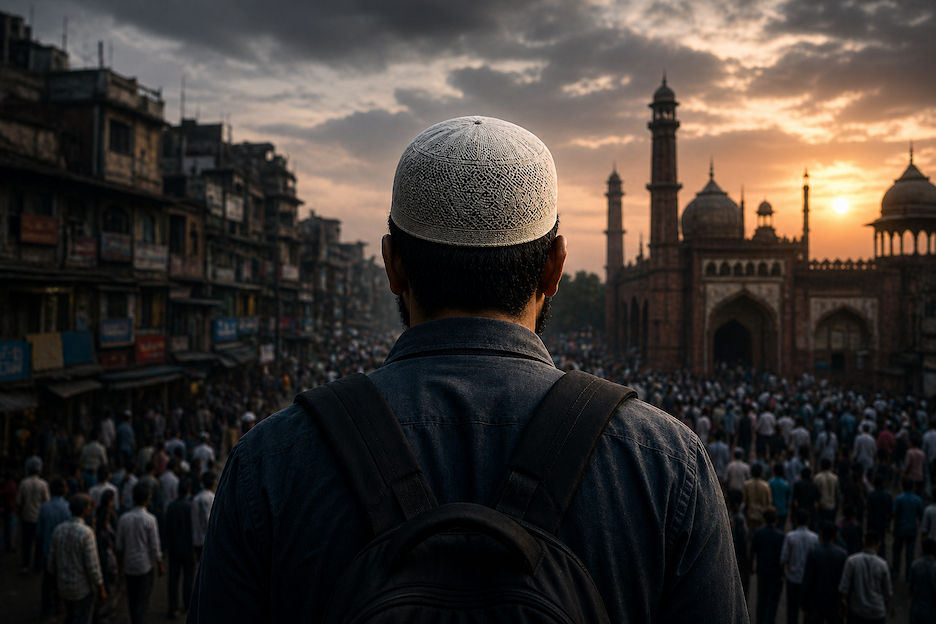
As usual, I opened my laptop and scrolled through the morning news before starting work. But what appeared on my screen that day was not just news—it was overwhelming. Hashtags like #SocialBoycott and #FullAbandon were trending, openly calling for the exclusion of Muslims in India. The effect was immediate. It unsettled me in a way that lingered long after I closed the screen. The anxiety stayed with me throughout the day, quietly shaping my thoughts, my mood, and even my ability to concentrate. For many Muslims in India, especially those who remain socially and politically aware, such exposure is no longer unusual—it has become part of everyday life.
This atmosphere is not accidental. Islamophobic rhetoric today extends beyond isolated remarks and has become embedded in public discourse. It appears in political speeches, media narratives, and digital platforms, often repeating familiar claims—that Muslims are suspect, excessive, or threatening. When such language is used publicly by those in positions of authority, it does more than offend; it normalizes exclusion. These narratives shape how communities are perceived and how individuals are treated, creating not only social distance but also a persistent sense of unease among those who are its targets.
I did not always have the language to understand this. One of my earliest encounters with prejudice occurred in 2008 at Allahabad railway station. While helping a pigeon return to its nest, a police officer approached me and asked my name. When I responded, he said, “Just go away, or I will frame you as a terrorist.” I remember walking away confused, unsure of what had just happened. In retrospect, that moment was not an exception but an introduction to a pattern in which Muslim identity is often viewed with suspicion. Accounts such as Mohammad Aamir Khan’s memoir Framed as a Terrorist reflect how such assumptions can escalate into systemic injustice, where identity itself becomes grounds for targeting.
As I grew older and began to express my identity more visibly—wearing a skullcap and growing a beard—the nature of these encounters changed. In 2012, while traveling from Lucknow to Delhi, I planned to stay briefly at a friend’s house before catching an early train. Despite reassurances, his landlord refused to let me enter after seeing me with a beard and a skullcap. I spent the night at the railway station instead, carrying not just my belongings but a quiet sense of humiliation that lingered far longer than the incident itself. Similar experiences followed. At Old Delhi railway station, I was singled out for a security check while others passed freely. My bag contained only books and clothes, yet the scrutiny felt less about safety and more about identity. Over time, such moments accumulate. One begins to anticipate suspicion even before it occurs.
What I experienced individually is not isolated; it reflects a wider pattern.
What begins as suspicion in everyday encounters often escalates into something more serious. This broader climate is reflected in patterns of violence that increasingly target visible Muslim identity. One of the most disturbing examples occurred in 2023, when a Railway Protection Force constable opened fire inside a moving train, killing three Muslim passengers and a Hindu colleague while shouting political slogans (reported in Hindustan Times). Reports noted that the Muslim victims were visibly identifiable by their appearance. The Washington-based research group India Hate Lab documented 1,165 such instances in a single year, with the overwhelming majority linked to visible markers such as beards, skullcaps, or traditional attire. The tragic cases of Junaid Khan, Abdul Samad, the Murshidabad lynching, and the Palghar railway station murder —all involving victims identified as Muslims due to their appearance—underscore this disturbing trend. These are not isolated events but part of a broader, systemic pattern of aggression.
Such incidents do not occur in isolation; they are shaped by a wider sociopolitical climate in which exclusionary rhetoric is normalized and, at times, publicly reinforced.
Living within this environment carries a psychological burden that is often less visible but deeply felt. Constant exposure to hostility—through news, social media, or personal encounters—creates a persistent sense of unease. It is not always expressed as fear in its most visible form, but as a quieter, ongoing anxiety that becomes part of daily life. Over time, this produces a state of anticipation: one begins to think ahead, to calculate risk, to prepare for possible reactions.
This affects everyday behavior in subtle but significant ways. Ordinary actions—traveling, speaking in public, or even choosing what to wear—are approached with caution. For visibly Muslim individuals, appearance becomes something to manage rather than simply express. Decisions that might otherwise be routine are shaped by the question of how they will be perceived and what might follow. This constant self-monitoring can be exhausting, reinforcing a sense of vulnerability in spaces that should otherwise feel ordinary.
Gradually, this leads to emotional fatigue. Many withdraw, limiting their engagement with news or public discussions in order to protect their mental well-being. It is not uncommon for people to deactivate social media accounts because the constant exposure to hostility becomes overwhelming. These are not simply personal choices; they are coping strategies shaped by the need to maintain a sense of stability.
Perhaps the most difficult aspect is how gradually these conditions become normalized. What once felt shocking begins to feel expected. Suspicion becomes routine. Silence becomes a strategy. And in navigating all of this, one is constantly aware that something as simple as “looking Muslim” can shape not only how others respond—but how one learns to live, think, and feel in their own country—where identity is no longer just who one is, but something that must constantly be managed.
Dr. Istikhar Ali is a DAAD Fellow at CeMIS, Universität Göttingen in Germany, and a researcher studying urban marginality, migration, and mental health in India.


Good Analysis.
But you can add such more examples regarding muslim hate like love jihad, land jihad, population jihad.
According to the report,2023 saw 668 hate speech events targeting muslims with 75% occuring in BJP ruled states.
Nuh Clashes (Haryana, August 2023)
Haldwani violance ( Uk, feb, 2024)
Cow vigilantism
It is a painful reality that a population of 250 million Muslims—equivalent to the population of the world’s sixth-largest country—is facing an environment of fear, humiliation, and the looming shadows of economic and social uncertainty. Yet, a global population of eight billion remains indifferent to this injustice. In this article, the author has shown merely a glimpse of the tip of the iceberg.
It is a painful reality that a population of 250 million Muslims—equivalent to the population of the world’s sixth-largest country—is facing an environment of fear, humiliation, and the looming shadows of economic and social uncertainty. Yet, a global population of eight billion remains indifferent to this injustice. In this article, the author has shown merely a glimpse of the tip of the iceberg.