
“Expressing my thoughts the way I truly want to has never been easy for me, precisely because I am both a Muslim and a political cartoonist.”
These are the words of cartoonist Sameer Akhtar Shaikh, written in an article published on the website of Outlook magazine. He describes living with a constant sense of fear before expressing any opinion, a fear he believes is shaped and reinforced by the state itself. In his view, the state is especially uncomfortable with Muslim political cartoonists because they are often more attuned to, and outspoken about, the discrimination and violence faced by the Muslim community.
This fear is not unique to Sameer Akhtar Shaikh. It is shared by many Muslim cartoonists across India. More broadly, even cartoonists with secular views find it increasingly difficult to work freely if they choose to question or criticize the government. As a Muslim cartoonist myself, I live with the constant anxiety of wondering when, and on what pretext, I might become a target.
That is the harsh reality of India today: Muslim cartoonists are far more vulnerable to intimidation and retaliation than others. Before drawing cartoons about anti-Muslim violence, attacks by Hindutva groups, lynchings carried out in the name of cow protection, extrajudicial killings, the demolition of Muslim homes with bulldozers, or so-called “encounters,” one is forced to think repeatedly about the consequences.
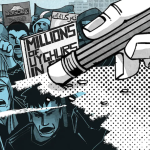
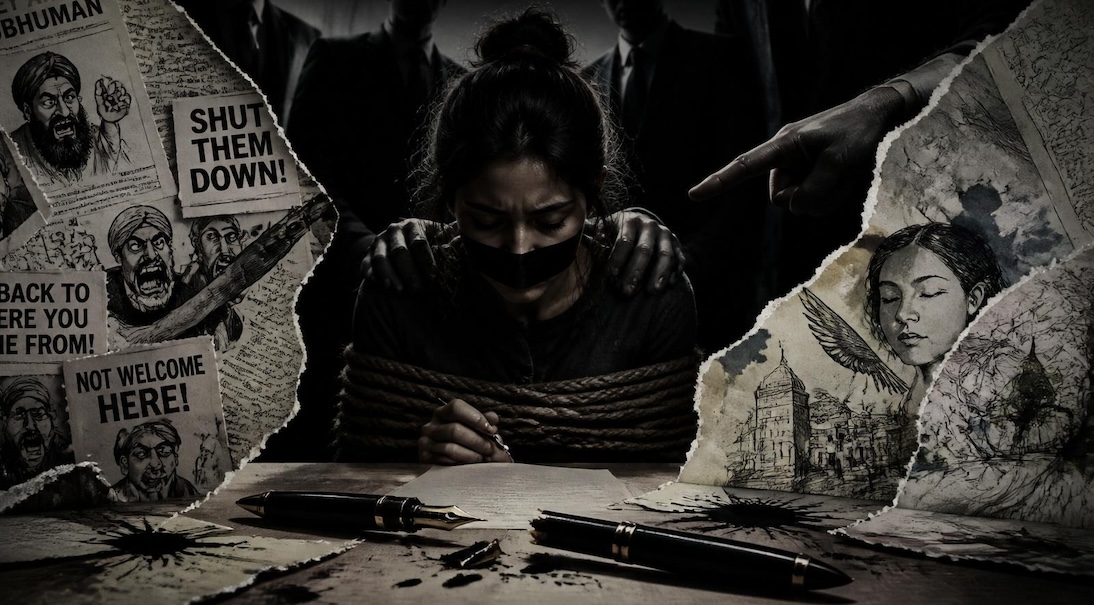
Over time, artists begin censoring themselves. They change words, soften imagery, dilute satire, and sometimes abandon ideas altogether. They know that even the smallest detail can be weaponized to brand them “anti-national,” “anti-Hindu,” or “radical.”
As a result, many cartoons die before they are even drawn.
This is a form of undeclared censorship, and its most dangerous feature is precisely that it is unwritten. There are no official rules, no formal bans, no public declarations. Yet the fear is everywhere, shaping what artists say, draw, and ultimately dare to imagine.
There was a time when political cartoons in newspapers and magazines were seen as the heartbeat of democracy. Their purpose was simple: to challenge power, provoke debate, and hold governments accountable through satire.
Today, that space in India’s mainstream media has all but disappeared. Critical voices, especially political cartoonists willing to question the government, have been steadily pushed to the margins. As a result, many cartoonists turned to social media, where they found audiences, solidarity, and a new space for public conversation.
But freedom there is limited too. The shadow of unofficial censorship hangs heavily over digital platforms.
The government has introduced sweeping regulations to control online content, using provisions of the IT Act and related digital rules to pressure platforms into removing posts and cartoons critical of its policies. According to critics, hundreds of posts are taken down each month, including cartoons addressing discrimination, violence, and the everyday realities faced by Muslims in India.
Yet state action is only one part of the story.
Social media has also become a battleground dominated by organized trolling networks. The BJP’s IT Cell and affiliated online groups routinely target cartoonists and artists who criticize Hindutva politics. Any cartoon questioning majoritarian ideology or exposing anti-Muslim rhetoric is quickly branded “anti-Hindu,” often triggering coordinated harassment campaigns against the artist.
At one point, a BJP leader demanded that the Quwwat-ul-Islam Mosque, located inside Delhi’s historic Qutub Minar complex, be handed over to Hindus, claiming that it was originally linked to the Hindu deity Vishnu. In response, I drew a cartoon suggesting that, by the same logic, Hindutva groups might one day even declare the Qutub Minar itself to be a Shivling, a symbolic representation of the Hindu god Shiva.
The reaction was immediate.
A Hindu cartoonist named Rajesh publicly condemned the cartoon, accusing me of hurting Hindu sentiments. Ironically, Rajesh himself regularly published political cartoons on social media. To him, the BJP leader’s claim appeared legitimate, while my satire was considered offensive.
That is the central paradox of political satire in today’s India: criticism of power is increasingly treated as an attack on faith.
On another occasion, I drew a cartoon about communal violence in which a BJP worker was shown with a burning tail, using it to set an entire city on fire. Almost instantly, Hindutva groups claimed the cartoon was insulting Hanuman, the Hindu deity who, according to mythology, set Lanka ablaze with his burning tail in the Ramayana.
The context of the cartoon did not matter. The intent did not matter. Even after repeated clarifications, many refused to engage with the actual point being made.
This is how the BJP’s online ecosystem often operates: facts are distorted, outrage is manufactured, and accusations are amplified to silence dissenting voices. At the same time, social media is flooded with propaganda cartoons and memes that openly demonize Muslims and spread Islamophobic narratives.
Yet Muslim cartoonists and artists who challenge this rhetoric are frequently portrayed as the real threat.
The irony is hard to miss: the same people who claim to find “insults to religion” in every critical cartoon are often the ones openly circulating caricatures that portray Muslims as demons, snakes, infiltrators, or terrorists.
Across social media, hundreds of pages now function as dedicated factories of Islamophobic propaganda. The cartoons and memes targeting Muslims are frequently far more aggressive, dehumanizing, and inflammatory than anything their creators accuse others of producing.
One example came ahead of Eid al-Adha, when Uttar Pradesh Chief Minister Yogi Adityanath declared that once mosques reached capacity, Muslims would not be allowed to pray on nearby streets. He warned that if Muslims did not comply “peacefully,” other measures would be taken.
Soon afterward, a cartoonist aligned with Hindutva ideology, known as Kuril, posted a caricature depicting Muslims as a dangerous snake, with Chief Minister Adityanath forcing a stick into its mouth. The message was unmistakable: an entire religious community was being portrayed as a threat that needed to be controlled.
This kind of content is not isolated. Islamophobic narratives are amplified daily through networks linked to Hindutva organizations, the BJP, and its online IT Cell ecosystem. Entire social media infrastructures have emerged to manufacture and distribute anti-Muslim propaganda through memes, cartoons, slogans, and viral misinformation.
Over the years, a vocabulary specifically designed to stigmatize Muslims has entered mainstream political discourse: terms such as “love jihad,” “land jihad,” “infiltrators,” and “population jihad” are repeatedly weaponized through cartoons and digital propaganda. Fear is deliberately cultivated among Hindus through claims that Muslims are rapidly outnumbering them, threatening their culture, or plotting to turn India into an Islamic state.
What begins as propaganda online rarely stays online. Over time, these images and narratives reshape public perception, normalize prejudice, and deepen social division.
A cartoonist named Kajal Kumar once drew a cartoon mocking the Islamic idea of the “72 Houris” in paradise. In the image, a man lies on his deathbed saying, “This is my final moment. Convert my religion now, so at least I’ll get 72 Houris in heaven.”
Similar cartoons circulated during U.S. military interventions in Muslim-majority countries, mocking innocent Muslims who were killed by suggesting that America had simply “sent them to their 72 Houris.” The deaths of civilians became material for dark political ridicule.
To promote Islamophobic narratives, Hindu nationalist groups frequently rely on terms such as “Bangladeshi infiltrators,” “terrorism,” “Love Jihad,” “Land Jihad,” and “cow slaughter.” These phrases are repeated so often through memes, cartoons, speeches, and social media campaigns that they gradually become embedded in public discourse.
During recent state elections in West Bengal, for example, numerous political cartoons portrayed the ruling secular party as a protector of “Bangladeshi infiltrators” and supporters of cow slaughter. Such imagery was widely circulated as part of a broader political campaign aimed at polarizing voters along religious lines.
What is striking is the imbalance in consequences.
Hindu nationalist groups often circulate openly inflammatory and misleading anti-Muslim content with little apparent fear of legal repercussions. Yet cartoonists who attempt to depict the discrimination, violence, or marginalization faced by Muslims often work under an atmosphere resembling an undeclared state of emergency.
And within this climate, the hardest thing is simply to remain honest as an artist.
Today, even satire is judged according to the identity of the person creating it. If a Hindu artist expresses a provocative political opinion, it may be praised as patriotism or nationalism. If a Muslim artist expresses the same sentiment, it is far more likely to be labeled “extremism,” “incitement,” or a threat to public order.
The health of a democracy should also be measured by the freedom of its cartoonists. Political cartoons do more than provoke laughter; they expose the truths that power tries to conceal.
In India today, the fear is no longer limited to arrest or censorship. It is the fear of online mobs, coordinated trolling, professional ruin, and public vilification. For Muslim cartoonists in particular, every line can become a risk, every satire a potential accusation.
But perhaps the greatest tragedy is quieter than all of this: the gradual moment when an artist begins censoring himself before anyone else can. That is how fear ultimately succeeds. And that, perhaps, is the most disturbing face of the “New India” — a country where Islamophobia is not only normalized in political discourse, but increasingly reproduced through humor, propaganda, and even cartoons themselves.